<h1 data-pm-slice="1 1 []">Diligence Without the Stress: Creating an Investor-Ready Data Room</h1>
<p>A term sheet can turn an exciting fundraising opportunity into a race against time. One day, a founder is discussing valuation and growth plans; the next, an investor requests years of financial statements, signed contracts, ownership records, and detailed forecasts. Suddenly, the finance team is searching through outdated folders, comparing spreadsheets, and trying to locate documents that should have been organized months earlier.</p>
<p>Investment deals do not always fall apart because a business lacks potential. Sometimes, the problem is that management cannot provide clear answers quickly enough. Delays, inconsistent figures, and missing documents can make investors question the reliability of the entire operation. <a href="https://www.k38consulting.com/saas-cfo-services/">Strategic finance for SaaS startups</a></p>
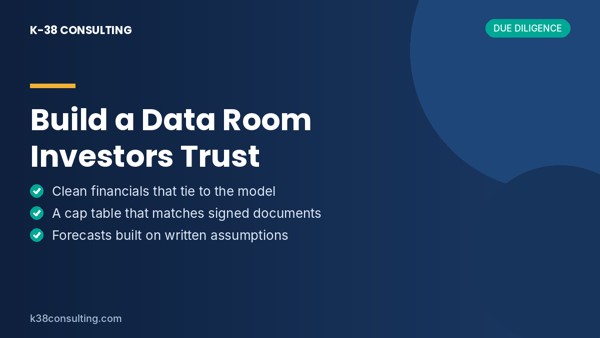
<p>An effective investor-ready data room makes verification straightforward. Financial reports should agree with the financial model, revenue figures should be supported by contracts and accounting records, and ownership information should match the company's legal documentation. Preparing these materials before fundraising begins gives founders more control over the process.</p>
<p>The objective is not to upload as many files as possible. It is to create a structured, accurate collection of information that allows investors to understand the business, evaluate risks, and confirm management's claims efficiently.</p>
<p>An organized data room demonstrates that the company takes financial reporting, governance, and investor communication seriously.</p>
<h2>Understanding Data Rooms and Investor Expectations</h2>
<p>A data room is a secure digital environment where a company shares confidential documents with potential investors, lenders, acquirers, and their professional advisers. Most fundraising and acquisition processes use a virtual data room (VDR) with permission settings, document controls, and activity tracking.</p>
<p>Investors rarely examine every document with equal attention. Instead, they focus on whether the company's financial performance is credible, its legal position is sound, and its leadership understands the factors influencing growth and profitability.</p>
<p>Missing information can create concerns that extend beyond the original request. In contrast, well-organized files, consistent financial figures, and clear explanations help establish confidence early in the review.</p>
<h3>Essential Documents for an Investor-Ready Data Room</h3>
<p>Although the exact requirements depend on the transaction and stage of growth, most investor due diligence processes cover several common areas.</p>
<ul data-spread="false">
<li>
<p><strong>Corporate and legal records:</strong> Formation certificates, bylaws or operating agreements, board resolutions, meeting minutes, and good-standing documents.</p>
</li>
<li>
<p><strong>Ownership and capitalization:</strong> Updated capitalization tables, equity incentive plans, stock option grants, exercise records, SAFEs, convertible notes, and warrants.</p>
</li>
<li>
<p><strong>Financial documentation:</strong> Monthly financial statements, tax returns, general ledger reports, and available reviewed or audited financial statements.</p>
</li>
<li>
<p><strong>Commercial information:</strong> Major customer and supplier agreements, pricing structures, sales pipeline reports, and customer retention metrics.</p>
</li>
<li>
<p><strong>Personnel and operations:</strong> Organizational charts, employment agreements, contractor contracts, intellectual property assignments, and employee benefit information.</p>
</li>
<li>
<p><strong>Intellectual property and compliance:</strong> Patent records, trademarks, licensing agreements, permits, and relevant regulatory documentation.</p>
</li>
</ul>
<p>Organize these materials into clearly numbered folders and create a master index. Each entry should identify the document, its date, and a short description. This structure allows the team to respond to specific requests without repeatedly searching through unrelated files.</p>
<h3>Explain Important Issues Before Investors Ask</h3>
<p>A concise explanatory memo can make complex financial information much easier to understand. For example, the financial folder might include a short note explaining the company's accounting methods, unusual expenses, significant changes in gross margin, or adjustments affecting reported earnings.</p>
<p>Addressing these matters proactively shows that management understands the numbers and has already investigated potential concerns.</p>
<h2>Strong Financial Reporting Begins With a Reliable Monthly Close</h2>
<p>A smooth due diligence process depends heavily on the quality of the company's accounting records. A carefully designed folder structure cannot compensate for incomplete reconciliations, outdated financial reports, or unexplained balances.</p>
<p>Reliable financial statements should generally follow an appropriate accrual accounting framework, such as U.S. GAAP when applicable. Balance sheet accounts need regular reconciliation, with supporting documentation available for significant balances.</p>
<p>Items such as deferred revenue, prepaid expenses, accrued liabilities, and outstanding receivables should be tracked using appropriate schedules. Financial statements should also agree with the general ledger and management reports, with adjustments documented clearly.</p>
<p>A consistent monthly closing process helps companies identify discrepancies early instead of discovering them during an investor review.</p>
<h3>Why a Quality of Earnings Review Matters</h3>
<p>A quality of earnings (QoE) review evaluates whether reported earnings accurately represent the company's underlying and sustainable financial performance. It commonly examines recurring revenue, operating expenses, unusual transactions, owner compensation, and other adjustments that may influence normalized earnings.</p>
<p>In mergers and acquisitions, buyers frequently commission their own QoE analysis. Some companies also obtain a sell-side review before entering the market.</p>
<p>Completing this work in advance can reveal accounting issues, clarify unusual financial movements, and give management time to resolve concerns before negotiations become more complicated.</p>
<h2>How to Explain Revenue Recognition During Investor Due Diligence</h2>
<p>Revenue recognition determines when and how much revenue a company records. Under U.S. GAAP, ASC 606 provides the principal framework for recognizing revenue from customer contracts.</p>
<p>Because revenue often influences valuation, investors examine the company's accounting policies and supporting documentation carefully. The appropriate presentation depends on the business model and the terms of its customer agreements.</p>
<h3>Revenue Recognition for SaaS Businesses</h3>
<p>Subscription software companies need to distinguish between customer billings, cash collections, and recognized revenue. When customers pay annually in advance, the unearned portion generally remains recorded as a contract liability or deferred revenue until the relevant performance obligations are satisfied.</p>
<p>Implementation services, discounts, usage-based charges, and multi-year contracts may require additional analysis and documentation.</p>
<p>Companies developing strategic finance for SaaS startups often prepare a monthly annual recurring revenue (ARR) bridge. This report separates new customer additions, expansion, contraction, and churn, helping investors understand changes in recurring revenue alongside the figures presented in GAAP financial statements.</p>
<h3>Financial Documentation for Biotech and Life Sciences Companies</h3>
<p>Biotech businesses may receive revenue through licensing agreements, research collaborations, milestone payments, royalties, and other arrangements. These contracts can contain several performance obligations, each potentially requiring different recognition treatment.</p>
<p>Grant income may also need to be presented separately, depending on the nature of the funding and the applicable accounting framework.</p>
<p>Founders building strategic finance for biotech startups should maintain a contract-level schedule describing the terms of each agreement, relevant performance obligations, milestone conditions, and the rationale supporting revenue recognition.</p>
<p>This documentation helps investors understand the relationship between reported revenue, research progress, and future commercial opportunities.</p>
<h3>Revenue and Margin Reporting for E-Commerce Companies</h3>
<p>Online retailers face their own reporting challenges. Returns, promotional discounts, marketplace commissions, shipping costs, and inventory valuation can significantly affect reported margins.</p>
<p>Companies seeking financial leadership for e-commerce startups can improve investor reporting by presenting contribution margin by sales channel. This analysis helps distinguish the economics of marketplace transactions from direct website orders after relevant fulfillment, transaction, and advertising expenses.</p>
<p>Clear channel-level reporting makes it easier to assess which growth opportunities are genuinely profitable and which depend on unsustainable spending.</p>
<h2>Cap Table Accuracy: Preventing Unnecessary Fundraising Delays</h2>
<p>A capitalization table records the company's ownership structure, including common shares, preferred shares, stock options, warrants, and convertible instruments.</p>
<p>Errors in this document can affect ownership percentages, investment calculations, and the terms of a financing round. In serious cases, missing approvals or incorrectly documented grants may require additional legal work before a transaction can close.</p>
<p>Investors' legal advisers typically compare the capitalization table with the underlying agreements. Founders should conduct their own reconciliation before granting access to the data room.</p>
<p>Review the following items:</p>
<ol start="1" data-spread="false">
<li>
<p><strong>Option grants:</strong> Confirm that grants have the required approvals, signed agreements, and appropriate supporting valuation documentation. For applicable U.S. stock options, this may include a current Section 409A valuation.</p>
</li>
<li>
<p><strong>Convertible instruments:</strong> Check that SAFEs and convertible notes reflect their actual valuation caps, discounts, interest terms, and conversion provisions.</p>
</li>
<li>
<p><strong>Vesting schedules:</strong> Ensure that vesting periods, cliffs, and acceleration provisions agree with the signed agreements.</p>
</li>
<li>
<p><strong>Option exercises and cancellations:</strong> Verify that exercised, expired, and forfeited options are recorded correctly.</p>
</li>
<li>
<p><strong>Post-financing ownership:</strong> Prepare a pro forma capitalization table showing ownership after the proposed investment and any anticipated option pool expansion.</p>
</li>
</ol>
<h3>Understand the Impact of Option Pool Increases</h3>
<p>Some investors request a larger employee option pool as part of a financing agreement. Depending on the negotiated terms, this increase may dilute existing shareholders before the new investment is calculated.</p>
<p>Modeling different outcomes before accepting a term sheet helps founders understand the potential impact on ownership and negotiate with better information.</p>
<h2>Building Financial Forecasts Investors Can Verify</h2>
<p>Investors do not expect every forecast to match actual results perfectly. They do expect assumptions to be logical, transparent, and supported by evidence.</p>
<p>A forecast built around a single revenue growth percentage provides limited insight. A stronger model connects revenue to sales capacity, pipeline conversion, pricing, customer retention, hiring plans, and other measurable business drivers.</p>
<p>Maintain a dedicated assumptions worksheet that identifies each major input, its source, and its relationship to historical performance. When an assumption differs significantly from previous results, explain why.</p>
<p>Common areas of investor scrutiny include:</p>
<ul data-spread="false">
<li>
<p><strong>New customer acquisition:</strong> Support projected growth with historical conversion rates, pipeline information, and sales representative productivity.</p>
</li>
<li>
<p><strong>Retention and churn:</strong> Use customer cohort analysis to demonstrate actual retention behavior.</p>
</li>
<li>
<p><strong>Gross margin:</strong> Explain expected improvements through supplier pricing, operational efficiencies, product mix, or other measurable factors.</p>
</li>
<li>
<p><strong>Hiring plans:</strong> Connect planned positions and compensation costs to specific business objectives.</p>
</li>
<li>
<p><strong>Cash runway:</strong> Show how long available cash is expected to last under different operating conditions.</p>
</li>
</ul>
<h3>Prepare a Realistic Downside Scenario</h3>
<p>A useful financial model includes base, upside, and downside projections. The downside case should demonstrate what happens if sales grow more slowly, fundraising takes longer, or operating costs exceed expectations.</p>
<p>It should also identify the actions management would consider to preserve cash, such as delaying selected hires, reducing discretionary spending, or adjusting expansion plans.</p>
<p>A credible contingency plan can demonstrate stronger financial discipline than an overly optimistic forecast with no clear response to setbacks.</p>
<h2>How Long Does It Take to Prepare a Data Room?</h2>
<p>The preparation timeline depends on the company's existing financial controls, legal documentation, and reporting practices. Businesses with reliable monthly accounting and organized records may prepare an initial data room within several weeks. Companies with outdated books, incomplete contracts, or capitalization discrepancies may need several months.</p>
<p>Starting at least six months before an anticipated fundraising or sale process can provide a useful preparation window, particularly when significant cleanup is required.</p>
<p>A practical preparation plan includes five steps:</p>
<ol start="1" data-spread="false">
<li>
<p><strong>Conduct an internal diligence review.</strong> Compare existing documents with a typical investor request list and identify missing information.</p>
</li>
<li>
<p><strong>Improve financial reporting.</strong> Complete reconciliations, resolve outstanding accounting issues, and document revenue recognition policies.</p>
</li>
<li>
<p><strong>Verify ownership records.</strong> Reconcile the capitalization table with signed agreements and work with legal counsel to correct discrepancies.</p>
</li>
<li>
<p><strong>Strengthen the financial model.</strong> Document assumptions, connect projections to historical results, and prepare alternative scenarios.</p>
</li>
<li>
<p><strong>Test the completed data room.</strong> Upload the files, organize folders, write explanatory memos, and ask someone outside the preparation team to review the structure.</p>
</li>
</ol>
<p>Growing businesses may not have enough internal finance resources to complete these tasks while managing daily operations. K-38 Consulting, based in Raleigh, North Carolina, provides fractional CFO and controller services nationwide, including fundraising preparation, financial modeling, and capital-raising support for businesses in areas such as SaaS, biotech, and e-commerce.</p>
<p>The benefit of external financial support is not simply document preparation. Experienced advisers can help identify questions investors are likely to raise and improve the quality of the company's answers before the review begins.</p>
<h2>Enter Investor Meetings With Confidence</h2>
<p>An investor-ready data room reflects the financial discipline behind the business. Timely monthly closes, documented accounting policies, accurate ownership records, and evidence-based forecasts make it easier for investors to verify management's claims.</p>
<p>Founders who maintain these practices throughout the year are better positioned to handle diligence without last-minute disruption. They can spend less time explaining inconsistencies and more time discussing growth opportunities, valuation, and the strategic direction of the company.</p>
<p>Start with a self-diligence assessment this quarter. Identifying weaknesses early gives management time to correct them before an investor makes the same discovery.</p>
<h2>Frequently Asked Questions About Investor Due Diligence</h2>
<h3>1. What documents belong in a data room for a seed or Series A round?</h3>
<p>An early-stage fundraising data room typically includes company formation documents, board approvals, an updated capitalization table, SAFEs and convertible notes, monthly financial statements, a financial model, important customer and vendor contracts, employment agreements, intellectual property assignments, and relevant patent or trademark records.</p>
<p>Seed-stage investors may request fewer documents than later-stage investors. However, maintaining a complete and organized set of records helps founders respond quickly when a lead investor requests additional information.</p>
<h3>2. Do investors require audited financial statements?</h3>
<p>Not in every case. Some seed and Series A investors accept internally prepared financial statements when the accounting records are reliable, reconciled, and consistent. Larger investors, lenders, and potential acquirers may require reviewed or audited statements depending on the transaction.</p>
<p>A buyer may also commission a quality of earnings review. Companies expecting more extensive financial scrutiny should establish strong closing and documentation procedures early to make future reviews more efficient.</p>
<h3>3. What is a sell-side quality of earnings report?</h3>
<p>A sell-side quality of earnings report is an independent financial analysis commissioned by a company before a potential sale or other major transaction.</p>
<p>It examines the sustainability of reported earnings, identifies unusual or nonrecurring items, and may evaluate adjustments involving owner compensation or other expenses. Identifying these issues before a buyer begins its review gives management more time to investigate discrepancies and explain the financial results.</p>
<h3>4. How detailed should an investor data room financial model be?</h3>
<p>The model should allow investors to trace major financial results back to understandable assumptions without making the analysis unnecessarily complicated.</p>
<p>Many investors expect monthly projections for the next 12 to 24 months, followed by annual projections for later periods. A useful model includes historical financial results, a separate assumptions worksheet, and base and downside scenarios. Additional scenarios may be appropriate when the business faces significant uncertainty.</p>
<h3>5. Who should be allowed to access a virtual data room?</h3>
<p>Access should be restricted to authorized participants who have an appropriate confidentiality arrangement in place. The exact process depends on the transaction and the company's legal advice.</p>
<p>Early-stage discussions may involve sharing a pitch deck and summary financial information. After a term sheet or at a later diligence stage, the company may provide broader access to the lead investor and its professional advisers.</p>
<p>Virtual data room platforms can offer folder-level permissions, watermarking, and activity tracking. These controls help companies manage confidential information and limit unnecessary exposure of sensitive customer, employee, and commercial records.</p>
<h3>6. When should a company start preparing its data room?</h3>
<p>Preparation should begin well before fundraising or a potential sale. Starting approximately six months ahead can give the finance team time to resolve accounting issues, verify legal records, update financial forecasts, and correct capitalization discrepancies.</p>
<p>Companies with well-maintained records may need less time, while businesses with significant documentation gaps may require several months of additional work.</p>
<h3>7. How can founders make financial due diligence easier?</h3>
<p>Founders can simplify the process by closing their books consistently, reconciling accounts monthly, documenting revenue recognition methods, maintaining accurate ownership records, and building forecasts around measurable operating drivers.</p>
<p>A master document index, clear folder structure, and short explanatory memos also reduce the time investors spend requesting clarification. Most importantly, financial reports, legal documents, and management presentations should tell a consistent story.</p>
<h3>8. Why does data room quality influence investor confidence?</h3>
<p>A well-maintained data room demonstrates that the company understands its financial position, maintains appropriate records, and can respond to important questions with evidence.</p>
<p>Missing documents, inconsistent figures, and unexplained accounting adjustments can increase perceived risk. Organized information does not guarantee an investment, but it can make the review process more efficient and help investors evaluate the opportunity with greater confidence.</p>
<!-- Comments are visible in the HTML source only -->