# Ashoka Tree vs False Ashoka Tree: Key Differences Explained
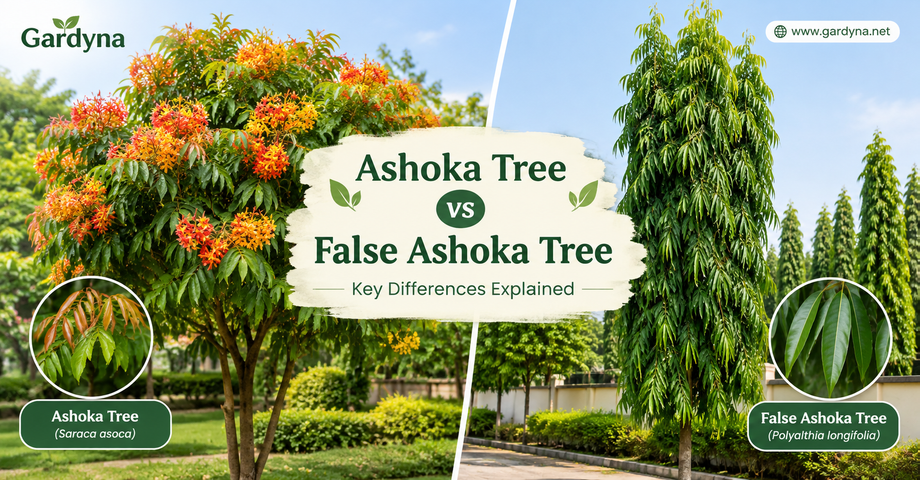
Ashoka tree (Saraca indica) is a popular ornamental tree in India, appreciated for its beautiful foliage, fragrant flowers, and cultural significance.
Many are confused by the true **[Ashoka tree](https://gardyna.net/blog/ashoka-tree/)** with a very different appearance and growth habit: the False Ashoka tree. Understanding the differences can aid gardeners in selecting the appropriate tree for their landscape.
## What is the Ashoka Tree?
Saraca asoca is the scientific name of the true ashoka tree. A small to medium-sized evergreen tree with attractive foliage and bright flowers. The tree tends to form a wide, rounded form and is frequently used in gardens and landscapes.
It produces flowers that may turn yellow, orange, or red during the blooming period. Ashoka is a very attractive tree, with its dense foliage and colorful flowers, which can be planted in appropriate outdoor areas.
## The False Ashoka tree is…?
False Ashoka tree is most commonly used to refer to Polyalthia longifolia, the same tree that is also commonly known as the Indian mast tree. Although called Ashoka, it is not Saraca asoca.
The growth form of False Ashoka is tall and narrow, columnar. The tree has long, slender leaves that droop from the branches. Upright in growth, it is frequently planted out along roads, boundaries, entrances, and formal landscapes.
In this article, we will be highlighting the key differences between the Ashoka Tree and the False Ashoka Tree.
### 1. Scientific Name
The true Ashoka tree is Saraca asoca, and the False Ashoka tree is Polyalthia longifolia. They are in different botanical groups because of the difference in scientific names.
### 2. Growth Habit
Ashoka tree tends to be broadly spreading and rounded. The False Ashoka is tall and narrow in contrast, and best used on sites where space is limited horizontally but not vertically.
### 3. Leaves
The leaves of Ashoka are compound and are pinnately arranged. Young leaves can be soft and reddish prior to greening.
The leaf of False Ashoka is long, narrow, shiny, and slightly wavy. It has a dense leaf surface which forms a green column.
### 4. Flowers
The flower heads of the true Ashoka are of special interest. Flower colour fades with ripening and can provide a dramatic effect during flowering time.
Flowers are much smaller and inconspicuous in False Ashoka. It is mainly valued for its foliage and high upright form, rather than for the size of ornamental flowers.
### 5. Landscape Use
Ashoka tree is commonly used as a garden tree that is required to produce flowers, leaves, and a traditional ornamental form. Another name for False Ashoka is Upright Ashoka and is frequently used for screening, avenues, boundaries or narrow sites.
## Which of the two to plant?
This will depend on the garden space you have and the look you are going for. The true Ashoka tree might be considered an ornamental tree with a spreading growth habit and ornamental flowers. For a tall, slender tree to screen, or a formal landscape, False Ashoka may be suitable.
## Final Thoughts
The Ashoka tree and False Ashoka tree are frequently confused due to their common name, but they are different species with different features. Saraca asoca is valued for its flowers and beautiful canopy, whereas Polyalthia longifolia is valued for its tall, narrow growth and elegant foliage.
Knowing these differences helps you to better determine the tree that suits your garden.
If you found this article helpful, you may consider other article on **Gardyna.net**